
Track & Field and Civil Rights Movement
Track & Field and Civil Rights Movement
We were in the final month of the school year, and my upper elementary students were deep into an American History unit. They were analyzing the complex era stretching from the end of World War II into the Vietnam War, with a specific focus on the Civil Rights Movement and its leaders. I really wanted to do something in conjunction with their studies, and the weather was so nice, I wanted to take advantage of the outside.
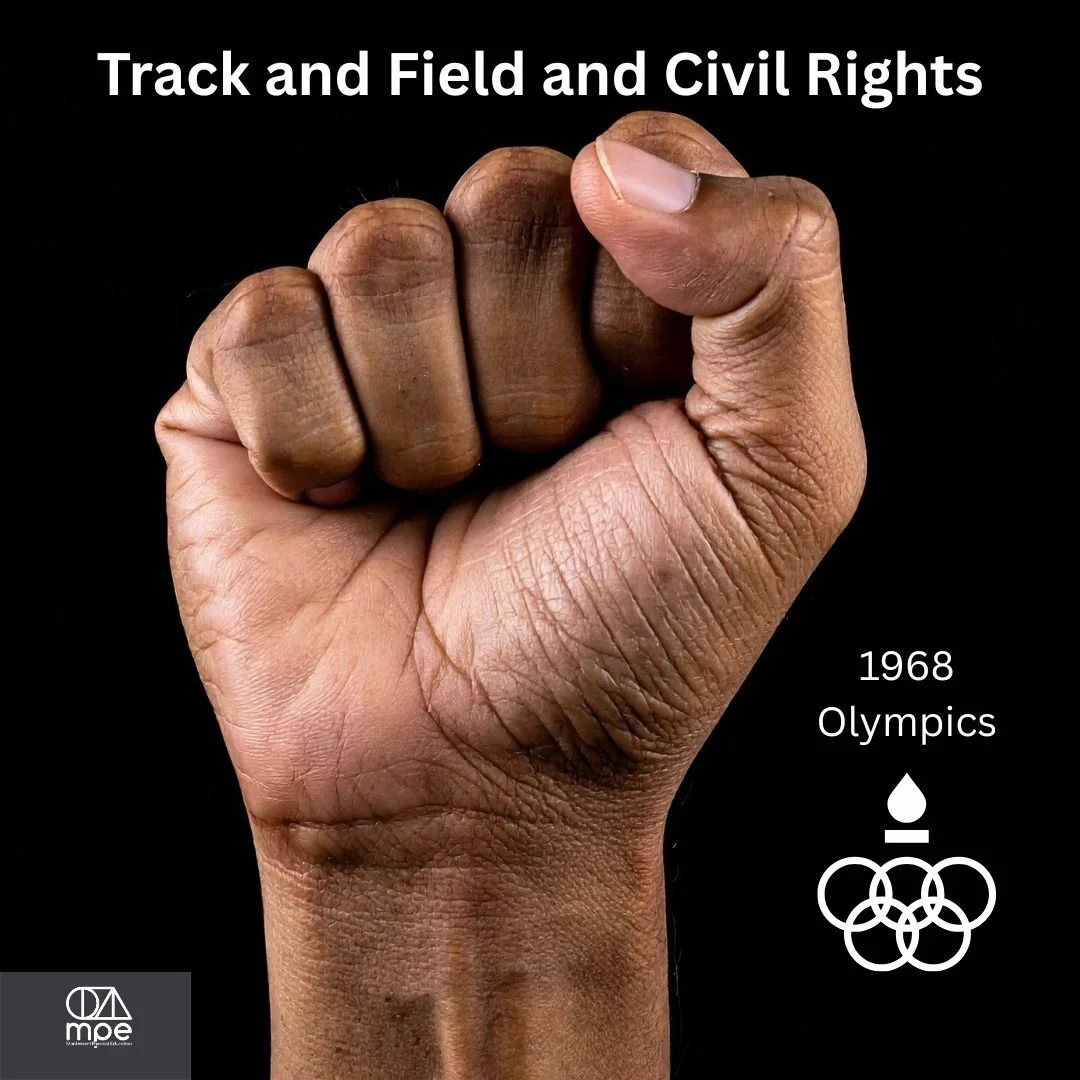
When I started thinking about the Civil Rights era, Malcolm X, Rosa Parks, and Martin Luther King obviously come to mind. What about sport and civil rights? Then I remembered that iconic, haunting image from the 1968 Olympics: two Black American runners on the podium, heads bowed, black-gloved fists raised defiantly against the sky. I knew it was a protest, but if I’m being completely honest, I didn't know the whole story. I didn’t remember it being taught with any real weight in school. It served more as a random historical footnote to pass a test than as an explosive moment of sacrifice. In my experience, as a grade school student, "White America’s" immense, vitriolic pushback against those men had been largely sanitized in standard curricula. I wanted to change that for my students.
Since we were wrapping up our track and field season, which is a massively popular sport at our school, I saw a natural hook. I decided to build a lesson that started with pure, high-intensity running and ended with the raw reality of the Civil Rights Movement. I purposefully kept the 1968 connection a total secret. I wanted the element of surprise to hit them when they least expected it. Here is how that day looked, and how you can run this exact integrated unit in your own school.
Materials:
· Measuring tape or pre-measured markers
· Cones (for starting lines, finish lines, and the 75-meter halfway point)
· Relay batons
· Stopwatch
· A print or high-quality digital display of the 1968 Olympic podium photograph
Minimum Number of Students:
· Ideal Number: 25 students (This is the ideal class size for structuring even teams, though the lesson can easily be adapted for larger or smaller cohorts).
Prior Knowledge:
· Students should currently be studying or have recently studied mid-to-late 20th-century American History, specifically the Civil Rights Movement, its leaders, and the systemic challenges faced by African Americans during this era.