
Fission and Fusion
Fission and Fusion
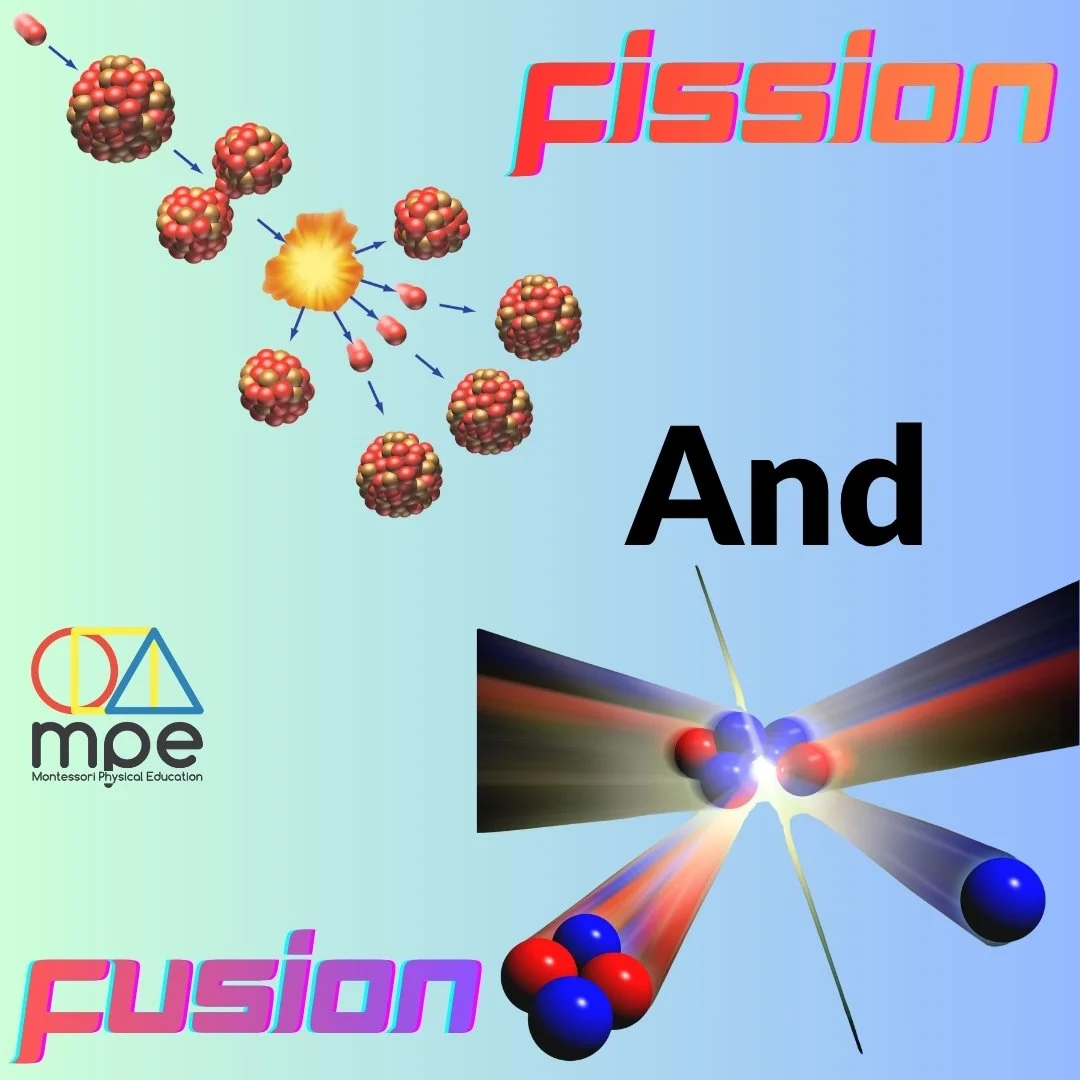
Nuclear fission and nuclear fusion are two processes that release enormous amounts of energy, but they do so in very different ways. Fission occurs when a heavy atomic nucleus splits into smaller nuclei, while fusion occurs when two lighter nuclei combine to form a heavier nucleus.
During nuclear fission, a neutron may strike and be absorbed by a heavy nucleus, causing it to become unstable and split apart. This process releases energy and additional neutrons, which may cause other nuclei to split, creating a chain reaction. Nuclear fusion works in the opposite direction. Two lighter nuclei must come close enough together to overcome their electrical repulsion and combine into a heavier nucleus, releasing energy under the appropriate conditions.
This lesson introduces students to these two nuclear processes through two very different throwing games.
In Fission, students play a modified dodgeball game in which they attempt to knock down wooden block towers representing heavy, unstable atomic nuclei. Dodgeballs represent neutrons traveling toward the nuclei. Defenders protect their towers and earn points by stopping incoming balls, but knocking down an opposing tower immediately wins the round.
In Fusion, the entire class works together to make dodgeballs collide in midair within a designated reaction area. Students quickly discover that getting two moving objects to collide is considerably more difficult than hitting a stationary target. Through repeated attempts, they may develop strategies involving communication, timing, and coordinated throwing. The difficulty of hitting a moving target (flying dodgeball) it supposed to represent the difficulty we have on Earth creating a sustained (cold) fusion for energy production.
These activities are particularly appropriate when students are studying the periodic table, atomic structure, and chemistry. As students begin exploring different elements, they may encounter radioactive symbols and wonder what radioactivity means. Fission and Fusion provide a physical introduction to two important nuclear processes and can lead to further discussions about radioactive elements, nuclear energy, and the processes that power stars.
The games are simplified physical models. They demonstrate the fundamental difference between splitting nuclei and combining nuclei, rather than reproducing every aspect of nuclear physics.
Materials
Eight hula hoops
Large wooden building blocks, enough to construct eight towers
I have two Giant Jenga sets that I use for this lesson
Eight softball-sized Gator Balls (four of each color)
Gator Balls are small foam dodgeballs with a durable outer skin. Many companies make them, but I found Gator to be the most consistent.
o Using two different ball colors makes it easier to ensure that each team begins with four balls and prevents students from quietly collecting additional balls before the round begins.
Cones or floor markings, if needed
Stopwatch or timer
Scoreboard or another method for recording points
Minimum Number of Students Needed
8 students, with larger groups divided into two equal teams.
Prior Knowledge
Students should have a basic understanding of atomic structure, including protons, neutrons, electrons, and the nucleus. They should also understand that elements are identified by their number of protons and that some atomic nuclei are unstable.
Before beginning, briefly review the difference between fission and fusion:
Fission: A heavy nucleus splits into smaller nuclei.
Fusion: Two lighter nuclei combine to form a heavier nucleus.