
Egg Thief
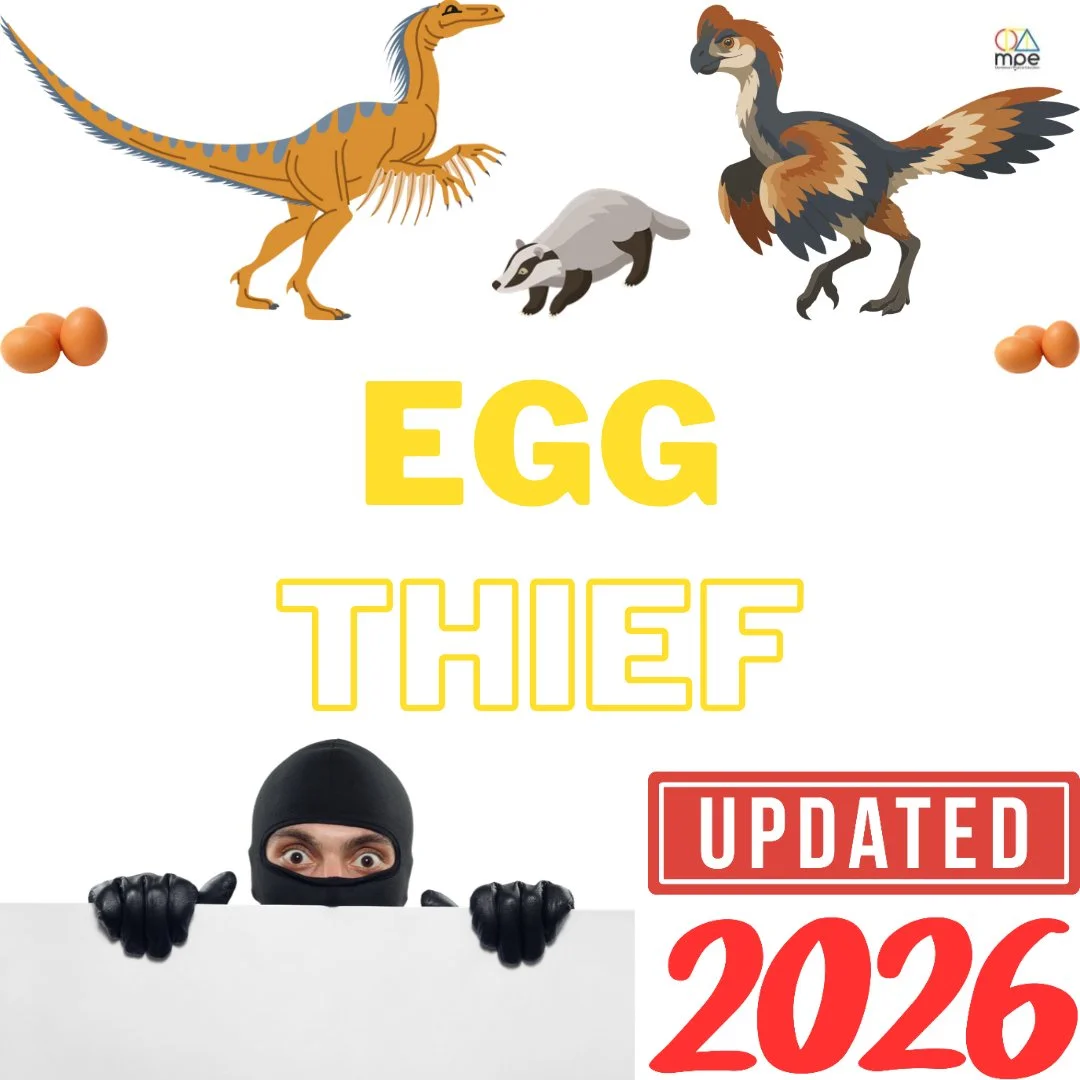
Egg Thief
Introduction
Capture the Flag is a childhood favorite, and students of all ages are usually familiar with the game. Since my students love playing it, I wanted to find a way to connect it to the Montessori classroom curriculum. One day, while playing Capture the Flag with small white soccer balls, I couldn’t help but notice how much they looked like eggs. That observation eventually inspired me to create Egg Thief.
When I first introduced the game, I told students they were Oviraptors stealing eggs from each other’s nests. However, one of my students pointed out that Oviraptors had been given a bad reputation, so I decided to investigate it. The name Oviraptor literally means “egg thief,” and the dinosaur received that name because its fossils were discovered near a nest of eggs. Scientists initially believed it had been stealing and eating them. Later discoveries, however, suggested that Oviraptor was more likely protecting and incubating its own eggs rather than stealing someone else’s.
While Oviraptor may have been unfairly accused, egg predation was a real part of prehistoric ecosystems. Dinosaurs faced competition from other dinosaurs, and they shared their environments with early mammals, some of which may have eaten dinosaur eggs. Losing eggs to predators was one of the many challenges these animals faced, but the consequences of those losses depended partly on the environmental conditions in which they lived.
Under favorable conditions, abundant food and successful reproduction could allow dinosaur populations to grow despite losing eggs to predators. However, approximately 66 million years ago, a massive asteroid struck Earth, triggering environmental changes that disrupted food chains around the world. With less sunlight reaching Earth’s surface, plant growth declined, affecting herbivores and the predators that depended on them. As food became scarce, maintaining healthy populations and successfully reproducing became increasingly difficult. Under these conditions, losing eggs to predators could have placed additional pressure on some already struggling dinosaur populations. Egg predation was not the primary cause of the extinction of non-avian dinosaurs, and its precise contribution remains uncertain. However, it provides an interesting way to explore how multiple environmental pressures can affect a population at the same time.
This updated version of Egg Thief allows students to experience those differences through gameplay. Two dinosaur populations compete to steal eggs from each other’s nests, while a third group represents small mammals that prey on their eggs. Before the asteroid, the environment supports reproduction, allowing dinosaur populations to replace their losses and potentially grow. After the asteroid, reproduction declines, and eggs lost to predation are no longer replaced. Students count their eggs before and after each game, allowing them to observe the differences between population growth, decline, and reproductive collapse. One dinosaur team may win the competition while both populations are growing. Later, a team may win despite finishing with fewer eggs than it started with.
The game naturally connects to the Montessori Timeline of Life and is also a gentle way to introduce Capture the Flag to first graders who have never played this game before!
Materials
· Open gym or field with room for two dinosaur territories and a central mammal area.
· At least 12 small sports balls (six per dinosaur nest), plus extra balls for pre-asteroid reproduction.
· If in the gym, basketball half-court line and volleyball ten-foot/attack lines, If outside, use cones to mark equivalent boundaries.
· Cones to mark protected nests and jail areas.
· Four-minute timer
· Container for extra and removed eggs.
· Optional paper or whiteboard to record egg counts after each round.
Participants
· Lower Elementary (6–9): second graders versus third graders as dinosaur populations; first graders become the mammals after observing the demonstration.
· Upper Elementary (9–12): everyone starts on one of two dinosaur teams. After the demonstration, approximately 20% of students move into the mammal group, drawn from both teams. For 20 students, use eight dinosaurs per team and four mammals.
Prior Knowledge
· The lesson connects to the Montessori Timeline of Life, the Mesozoic Era, early mammals, and the asteroid impact approximately 66 million years ago. No previous Capture the Flag experience is required.