
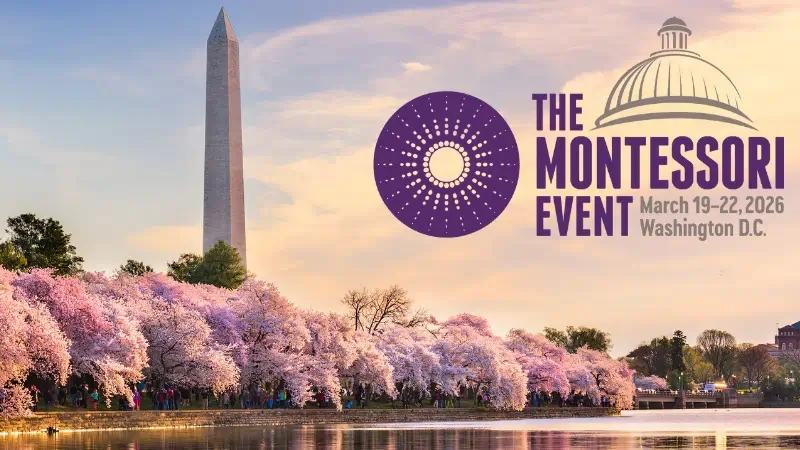
Every year, the AMS Montessori Event brings together thousands of Montessori educators from around the world to learn, collaborate, and celebrate the work we all care so deeply about. It’s one of the largest gatherings in the Montessori community anywhere in the world, and this year the multi-day conference will take place in Washington, D.C.
The scale of the event is truly remarkable. According to last year’s statistics, more than 4,000 educators registered, representing over 900 schools from 13 different countries. The conference featured 215 speakers and 160 sessions, offering attendees an incredible range of ideas, research, and practical tools to bring back to their schools.
So you can imagine how honored I am to be one of those speakers this year.
After applying to present at the conference for many years, having a proposal accepted feels like a milestone moment. I’ll be presenting alongside Rogers Park Montessori Head of School Ben Blair, and together we’ll lead a session on how to start an athletics program at your Montessori school.
Athletics and the Montessori Child
When people picture a Montessori school, they often imagine peaceful classrooms, children working independently with materials, conducting science experiments, or making music with tone bars.
What most people don’t picture is athletics.
It can sometimes be difficult to imagine the athletic Montessori student. But if we are serious about educating the whole child, then physical capability and athletic development deserve a place alongside academic, social, and emotional growth.
This idea is far from new.
The ancient Greek philosopher Plato strongly believed that physical fitness was essential for intellectual development. Interestingly, Plato was actually a nickname—his given name was Aristocles. The name “Plato” roughly translates to “broad-chested,” a nod to his strong build and reputation as a talented wrestler when he wasn’t contemplating life, knowledge, and the universe.
In other words, the idea that a strong body supports a strong mind has deep roots in educational philosophy.
Why Athletics Haven’t Always Been a Focus in Montessori
If athletics are part of developing the whole child, why haven’t sports traditionally played a larger role in Montessori schools? One of the biggest roadblocks has historically been the idea of competition.
When we hear the word competition, we often imagine people trying their hardest to succeed. But we also can’t ignore the other behaviors that sometimes appear alongside intense competition, like arguments, hurt feelings, ego, and conflict (even from spectators, too!). Competition can feel like a struggle, almost like a battle. On the surface, that seems antithetical to the Montessori emphasis on peaceful communities and respectful relationships. And to be fair, without the proper preparation, competition will bring those behaviors out in people.
But the key word there is preparation.
If we approach athletics the same way we approach classroom culture by intentionally teaching sportsmanship from the very beginning, competition can become something very different. In the Montessori classroom, we explicitly teach grace and courtesy. We model how to speak respectfully, how to resolve conflict, and how to support one another in community. What if we did the same thing in athletics?
Instead of competition producing negative behavior, it can help form the kind of athlete who inspires others through effort, respect, and humility. The real shift happens when we reframe what competition actually is. Rather than viewing it as a battle, we can begin to see it as a form of collaboration.
At first, that idea might sound strange. How can competing teams possibly be collaborators? One helpful way to think about it is through the lens of the engineering design process. Every team begins with an idea. A coach and team develop a framework for how they want to play: what offensive system they’ll run, how they’ll defend, and what strategies will best highlight their strengths while minimizing weaknesses. The players themselves become the constraints, because teams rarely add players mid-season.
Once the plan exists, the team begins practicing it over and over again. Each repetition refines the idea. Each drill sharpens execution. In engineering terms, this is prototyping. You build version after version until you believe the design is ready. But how do you know if the prototype works? You have to test it.
If this were an engineering prototype, you would test it in the real world and hope it doesn’t explode or fall apart. In sports, the test is a game played against another team that is actively trying to stop you from doing exactly what you planned to do. Now the prototype is truly under pressure. If the strategy works, you experience more success than failure, and maybe you even win the game. But what happens when it doesn’t work?
That’s where the real learning happens.
A thoughtful team must be honest and analytical about where the strategy broke down. Those weak points become areas for refinement. The prototype gets adjusted, improved, and tested again in the next game. Seen this way, the opposing team becomes an unexpected collaborator. They reveal exactly where your system needs improvement. This cycle repeats throughout the season—practice, prototype, test, refine—until, hopefully, by the playoffs, the team has built the strongest version of itself possible.
The same idea applies to the individual athlete.
Players are constantly prototyping their own abilities: practicing pivot steps, developing post moves, refining footwork, or improving their shot. When an individual athlete unlocks a new skill, it actually changes the constraints of the entire team. Suddenly, the strategy can expand because the team now has a new capability available. What’s exciting about this individual “prototype” is that it isn’t limited to a single season or even a single team. The process can continue for as long as the athlete chooses to keep playing.
You could certainly call this a growth mindset. But in many ways, it also reflects something equally powerful: a tinkering, engineering mindset in which improvement happens through curiosity, iteration, and continuous refinement. And when we look at athletics through that lens, competition begins to look a lot less like conflict and a lot more like collaborative learning in motion.
Our Session: The “How,” Not the “Why”
Our session at the AMS conference isn’t designed to convince schools that they must have athletics programs. Every Montessori school has its own priorities, resources, and culture.
Instead, our goal is to help the schools that have already decided athletics matter to them.
For those schools, the big question becomes:
“How do we actually do this?”
That’s where our presentation comes in. We’ll be sharing the practical steps, structures, and lessons learned from building athletics within a Montessori environment. From logistics and culture to implementation and sustainability, we want attendees to walk away with tools they can actually use.
And who knows. If there are a few educators in the audience who are still on the fence, maybe seeing what’s possible will help them imagine athletics as part of their own Montessori communities.
Celebrating with a Special Promotion
Having the opportunity to speak at the AMS conference feels like a moment I’ve been working toward for years. To celebrate, I wanted to do something special for the Montessori Physical Education community.
For a limited time, all Monthly and Yearly Memberships in the Members Area are 50% off.
Inside the Members Area, you’ll find:
175+ Montessori PE lessons
Nearly 40 video tutorials
Practical resources you can implement immediately with your students
And here’s the best part: any lessons you download are yours to keep, even if you decide to cancel your subscription later. The goal has always been to make high-quality Montessori physical education resources accessible to teachers everywhere, and this promotion is my way of saying thank you for being part of this growing community.
See You in Washington, DC
The AMS conference is always an inspiring experience, and I’m incredibly grateful for the chance to contribute this year. If you’re attending the conference in Washington, D.C., I hope you’ll consider joining our session—and if you see me in the halls, please come say hello. Thanks for your continued support of Montessori Physical Education. And hopefully… I’ll see you in D.C.