
We were in the final month of the school year, and my upper elementary students were deep into an American History unit. They were analyzing the complex era stretching from the end of World War II into the Vietnam War, with a specific focus on the Civil Rights Movement and its leaders. I really wanted to do something in conjunction with their studies, and the weather was so nice, I wanted to take advantage of the outside.
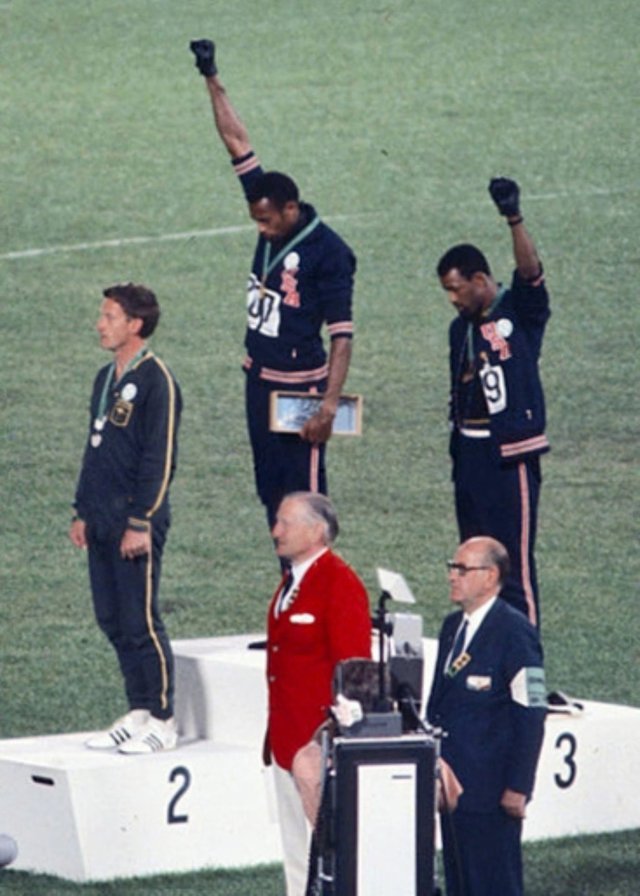
When I started thinking about the Civil Rights era, Malcolm X, Rosa Parks, and Martin Luther King obviously come to mind. What about sport and civil rights? Then I remembered that iconic, haunting image from the 1968 Olympics: two Black American runners on the podium, heads bowed, black-gloved fists raised defiantly against the sky. I knew it was a protest, but if I’m being completely honest, I didn't know the whole story. I didn’t remember it being taught with any real weight in school. It served more like a random historical footnote to pass a test rather than an explosive moment of sacrifice. In my experience, as a grade school student, "White America’s" immense, vitriolic pushback against those men had been largely sanitized in standard curricula. I wanted to change that for my students.
Since we were wrapping up our track and field season, which is a massively popular sport at our school, I saw a natural hook. I decided to build a lesson that started with pure, high-intensity running and ended with the raw reality of the Civil Rights Movement. I purposefully kept the 1968 connection a total secret. I wanted the element of surprise to hit them when they least expected it. Here is how that day looked, and how you can run this exact integrated unit in your own school.
With a class size of 25 students per class, I’m sure this lesson is adaptable for less or even more students. Because I wanted to be outside, we just used our driveway that leads to our parking lot as our “track.” It’s around 200 M, which is the distance that Smith and Carlos ran in the 68’ Olympics. For equipment, I had a measuring wheel to measure the driveway length, a bunch of batons, and my phone’s stopwatch.
I collected the children, but instead of walking into the gym, we headed outside to our school's long driveway, which stretched roughly 200 meters. We began with a simple, steady jog back and forth along the driveway to get their heart rates up. Next, the students formed a single, long line facing me. To establish a safe personal space, I had everyone hold their arms straight out to the sides like airplanes, ensuring no one was touching. We cycled through a rigorous routine of movements (first marching, then jogging) performed in place: High knees, butt kickers, big straight-leg "Frankenstein" kicks, single-leg balance dips, and explosive skipping.
Before we raced, we pivoted to the fundamentals of running mechanics. We spent a substantial amount of time practicing a bilateral coordination drill known as the A-March. On paper, the A-March sounds incredibly straightforward: it’s an exaggerated march. But in practice, it is a deceptively difficult drill that forces the brain to coordinate movement completely across the body's midline. For upper elementary kids who are still developing their baseline motor skills, it is a true neurological challenge.
How to cue the A-March: As the left knee drives upward into a high-knee position, the right arm must simultaneously drive up, forming a crisp right angle with the upper arm parallel to the ground. As the left foot snaps back down, the right leg drives up, and the left arm matches it.
Once their mechanics were locked in, I revealed the main athletic event. I had previously measured out a clear running lane of exactly 150 meters down the driveway. The heats were organized by grade level because our classes have nearly equal numbers per grade. While one group sprinted the 150 meters, the other two groups stood at the finish line, serving as official track judges to record placings and determine the winners in close races. While I don't normally emphasize winning and losing in gym, I needed to know the explicit placings for what came next.
Once every grade level had known their sprint placings, I brought them all back together to introduce baton-exchange mechanics. I explained the vital nuance of the hand-off: the receiving runner must begin accelerating before their partner reaches them to avoid a high-speed collision. I told them that while Olympic pros use a "blind exchange" (never looking back), we are not pros. A dropped baton means instant disqualification, so they needed to look the baton all the way into their hands.
Then came the strategic twist. I paired the students up for a two-person relay using an inverted bracket system:
1st Place paired with Last Place
2nd Place paired with Second-to-Last Place, and so on.
If you have an odd number of kids, just pull a student from another grade level to complete the pairing.
By anchoring the fastest kids with the slower runners, we created incredibly even matchups where the final finishes were razor-thin. This format forced the duos into deep strategic huddles: Do we put our fastest runner first to build a lead, or do we use them as the anchor leg to chase down the competition? We marked a cone at the 75-meter mark so the receivers would know where to stand. We ran the 4th-grade relay, then the 5th-grade relay, and finally the 6th-grade relay. The competitive energy was electric, and we saw every type of pairing win.
To empty whatever remaining fuel they had in their tanks, I offered an optional bonus round. My upper elementary kids love a “class vs. class” challenge, so we made a “record breakers” round. This was a 4-person relay framed as a weeklong attempt to set a school record. The first class of the week would set the baseline time, and every subsequent class would try to dethrone them. Because we were working within the constraints of a straight driveway instead of a circular track, I engineered a "shuttle loop" relay. The first runner starts at the 0M line and sprints 75 meters down the driveway to hand off the baton. The second runner receives the baton at the halfway mark and carries it all the way to the 150-meter finish line. The third runner takes the baton at the far end and sprints backward down the lane, returning it to the halfway mark. The anchor waits at the 75-meter mark, receives the final hand-off, and sprints across the original starting line where the teacher is waiting with the stopwatch.
I told the students they had a strict time limit to try to break the standing record. They ran, adjusted their orders, and immediately lined up to try again and again. Every class wanted more turns, displaying a drive I deeply admired, but the most important part of the lesson cannot be rushed. Now that the physical work was done and they were good and tired, they were in the right headspace to settle themselves and truly listen to a heavy story about civil rights and personal sacrifice.
I brought all 25 kids back to school and found a quiet place for our storytelling. Once they sat down and caught their breath, I pulled out the iconic photograph of Tommie Smith and John Carlos. On the back of the image, I made some notes for myself, but it was never a prepared speech. However, this was close to what I would say to the students.
“Why did we even do track and field today? I know the season is almost over, but there is another reason we ran today. What are you studying in class right now? The Civil Rights Movement. And there is an iconic photograph that perfectly illustrates how sport and politics, namely the Civil Rights Movement, intersected into one powerful moment.
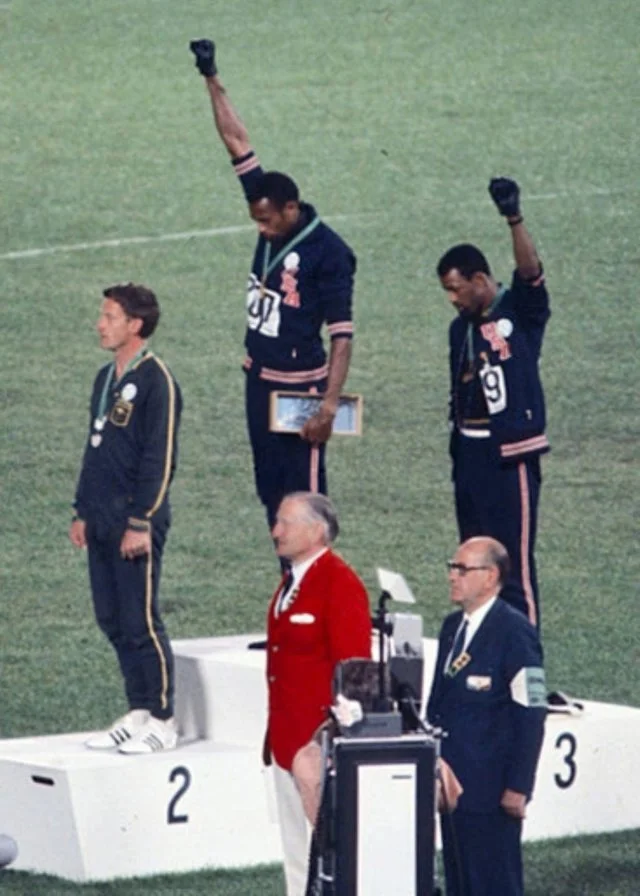
This picture is from the 1968 Olympics held in Mexico. Here we can see two Black Americans standing on the podium after the 200 M dash. The gold medalist and record breaker is Tommie Smith, and the bronze winner is John Carlos. This was during the medal ceremony, when the national anthem of the gold-medal-winning country is played. In sports, this podium is supposed to be the ultimate celebration. The world expects you to just smile, accept your medal, wave your flag, and 'shut up and play.' But these men used this oppurtunity to expose the injustice tolerated in the US to the world. 1968 was one of the bloodiest, most painful years of the Civil Rights Movement. Dr. Martin Luther King Jr. had been assassinated just six months earlier. Segregation, systemic poverty, and police brutality were tearing Black communities apart.
What a lot of history books don't emphasize is that this wasn’t a spontaneous stunt. This wasn't just two guys deciding to raise their fists on a whim. This was a highly organized, deeply calculated political movement. A year before the Olympics, Smith, Carlos, and a sociologist named Harry Edwards formed an organization called the Olympic Project for Human Rights, or the OPHR. Look closely at their track jackets in the picture. Do you see that small, round badge over their hearts? That is the OPHR badge.
Originally, the OPHR wanted every Black American to boycott the Olympics. 'Why should we run and win medals for a country that doesn't respect our basic human rights?' They demanded that apartheid South Africa be banned from competing. They demanded the restoration of Muhammad Ali's boxing title, which had been stripped away because he protested the war. They demanded more Black coaches. While the boycott didn’t happen, the mission remained intact with a new purpose. They were going to win and use the podium as their megaphone.
Look at their clothing. Look at their feet. They have no shoes on. They walked onto that world stage in plain black socks to show the world the crushing reality of Black poverty in America, where millions couldn't afford shoes. Tommie Smith wore a black scarf for Black pride. John Carlos unzipped his jacket, breaking strict Olympic protocol, to honor blue-collar working-class people. They only brought one pair of black leather gloves between them. Smith took the right, Carlos took the left. This was actually an accident: they were both supposed to wear gloves, but they turned it into a show of solidarity by each putting on one glove, which made the image even more iconic.
Look closely at John Carlos’s neck. He is wearing a heavy strand of beads. When asked why, he didn't mince words. He said:
'The beads were for those individuals that were lynched, or killed that no one said a prayer for, that were hanged and tarred. It was for those thrown overboard in the Middle Passage.'
When the anthem played, and those fists went up, the stadium didn't cheer. The crowd booed. They threw insults. And the institutional hammer came down instantly. The International Olympic Committee suspended them and expelled them from the Olympic Village within 48 hours. When they came home to America, they weren't treated like heroes. They received non-stop death threats. Their families were harassed. They were blacklisted from sports and couldn't find jobs. For decades, the public treated them like villains.
Even the white man on the silver podium, Peter Norman from Australia, suffered. Look at his chest. He is wearing an OPHR badge, too. He chose to stand in total solidarity with them. When he went home, his government punished him. They blacklisted him, refused to let him compete in the next Olympics despite having run Olympic qualifying times, and erased him from their history. When Peter Norman passed away in 2006, Tommie Smith and John Carlos flew all the way to Australia to be the pallbearers at his funeral.
It is a brutal, unfortunate reality of history: when you challenge the status quo, when you refuse to just ' shut up and play ball,' and when you become an active agent for peace, your life will suffer in the short term. The systems in power will try to break you. But look around today. Look at our history books, the murals in our cities, and the statues built on university campuses. The people and institutions that punished them are long gone, but the legacy of their sacrifice is cemented forever. Sports have never been just a game. They are a mirror to the world."
I chose to release this blog a bit earlier than my usual Sunday schedule to honor Juneteenth by sharing a real, actionable example of how we can bring the vital history of the Civil Rights era into the PE field.
Juneteenth marks a monumental day of liberation, celebrating the moment freedom was finally announced to the last enslaved Black Americans in Texas. But as history shows us, that announcement wasn't the end of the story. It was the beginning of a centuries-long fight to protect and realize that freedom. There was no magic wand. In fact, for most of American history, incredible, systemic forces actively tried to roll back, suppress, and reverse the hard-won liberties of Black Americans.
Ordinary and extraordinary individuals alike have had to step up, speak out, and put their lives on the line just to ensure that the foundational protections of the U.S. Constitution actually apply to all people in our country.
The 1968 Olympic protest by Tommie Smith and John Carlos was a direct continuation of that exact struggle. By bringing this moment into your gym or onto your track, you aren't just teaching running technique or relay strategies; you are helping your students reckon with the deep realities, sacrifices, and courage that defined the Civil Rights Movement.
Thank you for reading, thank you for teaching the hard truths, and Happy Juneteenth, everyone!
Photo attribution: https://commons.wikimedia.org/wiki/Category:Black_Power_Salute_at_1968_Olympics#/media/File:John_Carlos,_Tommie_Smith,_Peter_Norman_1968cr.jpg