
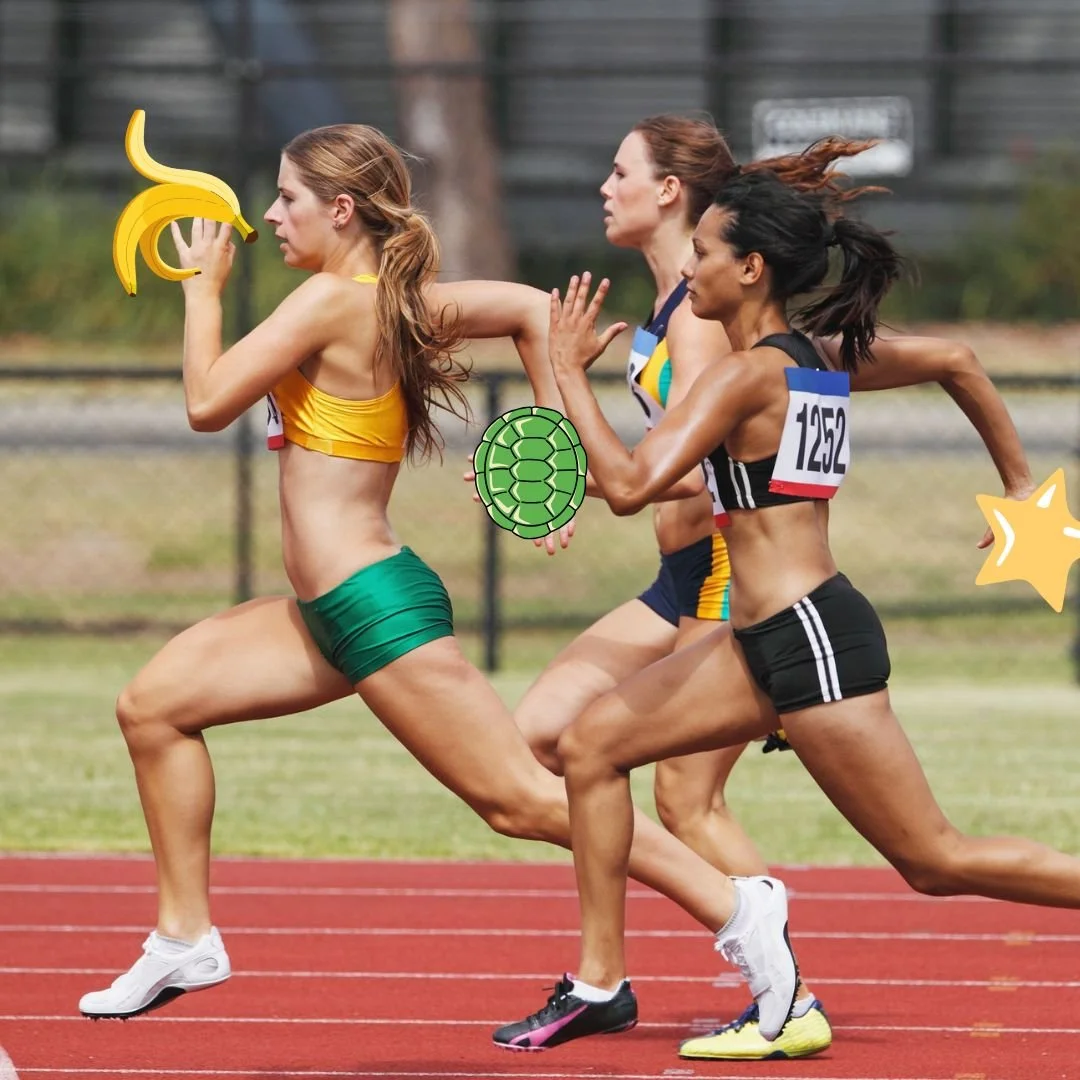
The 4 x 200M Mario Kart Relay
To make sure track practices are fun, we usually do our warm-ups, technique work, core running, and finish with a game. I find the games are sometimes the most useful thing outside of technique work for actually getting them to run hard. I’ve used this example before with students in PE where I highlight how much running a group did during a game, and then ask them to imagine, “what if I told them just to run the same distance, no game.” Kids would hate that. But insert it in a game, and the effort comes effortlessly.
One afternoon, I was thinking about which game would be the most fun to play at track practice when it dawned on me. Why not “video game-ify” a real race using something students already understand? A race inspired by Mario Kart (or really any racing game they’ve ever played)!
I usually build my games around classroom concepts, but this is track practice. Fun is the priority. So instead of forcing a connection, I leaned into it and built a race around one of the most recognizable gaming formats out there.
After a lot of iteration—and a full team of about thirty athletes testing, breaking, and refining the idea—I ended up with a version that holds up across different ages and ability levels. It’s been adjusted in real conditions, not just in theory.
If you’re a PE teacher looking to change up a running unit, a track coach, or someone who works with one, this is worth trying. My athletes not only enjoyed it but also began to recognize the strategy within it. Teams began thinking about how to match runners' strengths with specific power-ups, building a plan rather than just running laps.
At its core, it’s still a race.
And the result is exactly what you want:
They run.
The Game
Format
Teams of 4
Each runner completes 200M
(I initially did a 4 x 400 M, which was a lot for our younger ones and sprinters)
One fewer team races than the number of available lanes
The winning team stays on and moves to the outermost lane in the next race
Teams must cycle power-ups each heat—no repeating roles
Power-Ups
Each runner is assigned one power-up before the race.
Jersey (Banana)
Dropped in a neighboring lane. When an opposing runner gets to it in their lane, they must slow down, pick it up, and carry it while continuing to run.
Dodgeball (Shell)
One throw or tag only. If a runner gets hit or tagged, they step off the track and do five jumping jacks, then get back into their lane and continue. After completing their leg, the thrower must immediately retrieve the ball.
Baton (Star)
Provides full immunity for the entire 200M. The runner holds it for the duration of their leg.
Shortcut (Inside Lane)
The assigned runner begins their leg in the inside lane. They must be set before the incoming runner reaches the exchange zone and remain in that lane for the entire leg.
Core Rules
Activation
At the 100M mark, a coach calls “POWER-UPS LIVE!” All power-ups activate at that point, except for the shortcut, which is active immediately.
Exchange Control
Each team has an “On Deck” area. Only the current runner and the next runner are allowed near the exchange zone. Shortcut runners must move into the inside lane early from this position.
Inside Lane
Runners in the inside lane must maintain forward spacing. No intentional slowing. No passing from behind. They are still affected by all power-ups.
If affected by a power-up:
Jersey: step off the track, secure it, and continue. If there is a runner behind you, let them pass before picking up the jersey.
Dodgeball: step off, complete jumping jacks, and re-enter safely
Logistics
The game is designed to manage itself.
Any runner who uses the dodgeball retrieves it immediately after their leg
Any runner who picks up a jersey carries it
No equipment is left on the track
Color coordination by team is essential for organization and the speed for resetting the race for the next teams.
Why It Works
The structure introduces a single decision point at 100M. That alone changes pacing. Students accelerate into the midpoint because it represents an opportunity, not just distance covered.
Strategy develops without instruction. Teams begin to organize how and when to use power-ups, often adjusting based on previous races.
The rotation format keeps competition balanced. Teams that win continue racing but are pushed to the outermost lane, while new teams enter with an advantage.
Most importantly, the game removes downtime. Equipment is never left behind, transitions are quick, and races can run back-to-back without interruption.
Takeaway
This is still a relay. The running does not change.
What changes is the level of engagement. With a small structural shift, students run with more intent, make decisions under pressure, and stay invested from start to finish.
If This Is Useful
If this approach resonates, it’s part of a larger body of work built around a big idea. Integration. I have tons of lesson plans that integrate classroom concepts into physical education games that your students will love.
If you’re a PE teacher looking for something new, or a classroom teacher who has to do it all, these lessons can help bridge that gap, or at the very least give you more options and more ways to keep students engaged.
If you enjoyed this write-up, I encourage you to browse the individual lessons section for more free content.