
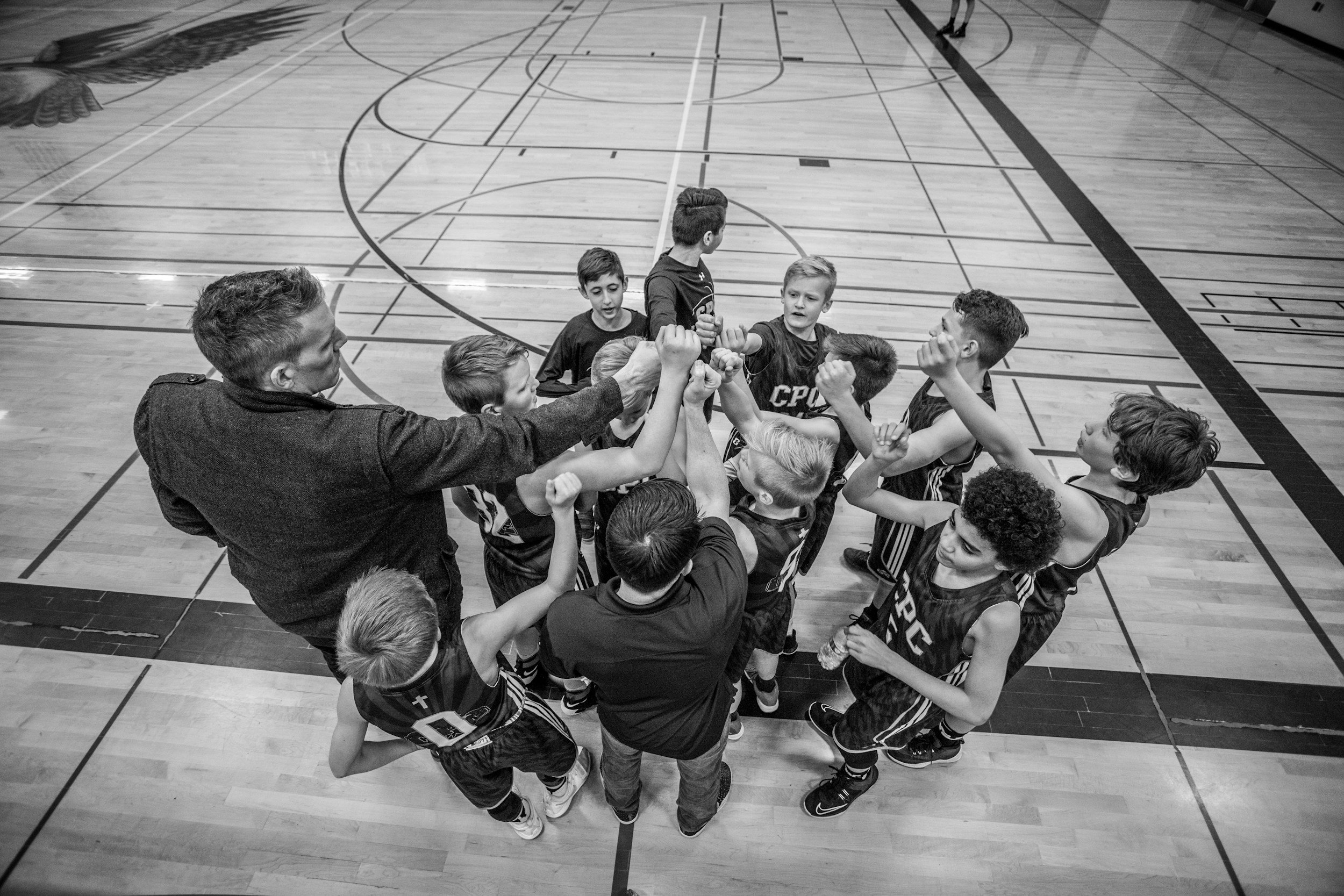
In Montessori, we love to teach in stories, hence the Great Lessons. This particular story comes from our first fourth-grade girls’ basketball team.
It was our first game of the season. We have twelve girls on the roster, which is a lot for one basketball team, but the demand was there. The team is a mix of experienced players and girls who have never played organized basketball before. As the coach, I had done what many of us do: I spent hours building the perfect rotation plan. I tried to maximize strengths, minimize weaknesses, and still honor our commitment to equal playing time. With twelve players, that puzzle is no small task.
Then the game started.
Within the first few minutes, it became clear that the other team was brand new. We later learned they had only had one practice. The mismatch was apparent, and by the middle of the first half, I knew my carefully crafted plan had to be thrown out entirely.
More importantly, I realized something else: if this game was going to be meaningful for them, it needed to look a lot more like a practice than a competition.
So we adjusted.
When a girl from the other team traveled with the ball, we asked the referee to stop play, explain what happened, show her how to fix it, and then let her try again. Procedural mistakes? Same approach. Teach first. Retry the second. Scoreboard last.
On our side, this turned out to be a best-case scenario. I was able to give our brand-new players significantly more playing time while anchoring each lineup with one experienced player. Those experienced players became the point guards (floor captains) even when that wasn’t their usual role in our starting rotation.
Our goals changed completely:
Every girl gets a legitimate shot at the basket.
Every girl makes a basket.
That second goal was Herculean. We have two girls who are about the size of first graders and struggle just to get the ball high enough to reach the rim. But that didn’t matter. What mattered was that we were going to squeeze every ounce of experience, confidence-building, and teamwork out of this moment.
And that’s when the magic started happening.
One of our taller girls, now playing point guard, spent possession after possession trying to get the ball to every teammate, passing up her own wide-open shots to make sure others had chances. After the game, a parent teared up telling me about a moment during free throws. When it was her daughter’s turn to shoot, our biggest player stood right next to her, offering encouragement and quiet support to a teammate who struggles mightily just to get the ball to the rim.
Yes, we won the game. But that was almost beside the point. No one on either team left disappointed or discouraged. Both teams accelerated their growth. We learned what needed work. They gained experiences they simply hadn’t had yet.
That showed up quickly.
The following week, we played the toughest team in our division and held our own for most of the game. The very next morning at practice, we focused on one specific skill: protecting the ball while still being able to see.
If you’re a coach, you’ve seen this a thousand times. A player feels pressure, pivots away to protect the ball, and suddenly can’t see anything—teammates, defenders, options. Defensive pressure is scary, especially for novice players. Hands are swiping. Bodies are close. You might get hit on the arm or the face. That sense of threat is precisely what good defense is designed to create.
So we practiced staying grounded, protecting the ball, and keeping our heads up and looking forward, even when it feels uncomfortable.
In other words, we were building tools to be courageous in the face of adversity.
When game time comes again, some girls will use those tools successfully. Others won’t—yet. That’s the process. That’s growth.
And this is why we play sports in Montessori.
These are experiences that simply don’t happen in the classroom, no matter how rich and intentional the academic environment may be. Youth sports offer a safe yet intense simulation of the challenges young people will face as adults: pressure, cooperation, leadership, empathy, courage, and adaptability.
As our world becomes more urban, more scheduled, and more screen-bound, sports remain one of the last consistent spaces where children can practice these life skills in real time, with real consequences, and authentic human connection.
We don’t play sports just to win.
We play so the child can become a capable, confident, and compassionate adult that we know they can become.
“In every child is the seed that will mature into an adult.”