
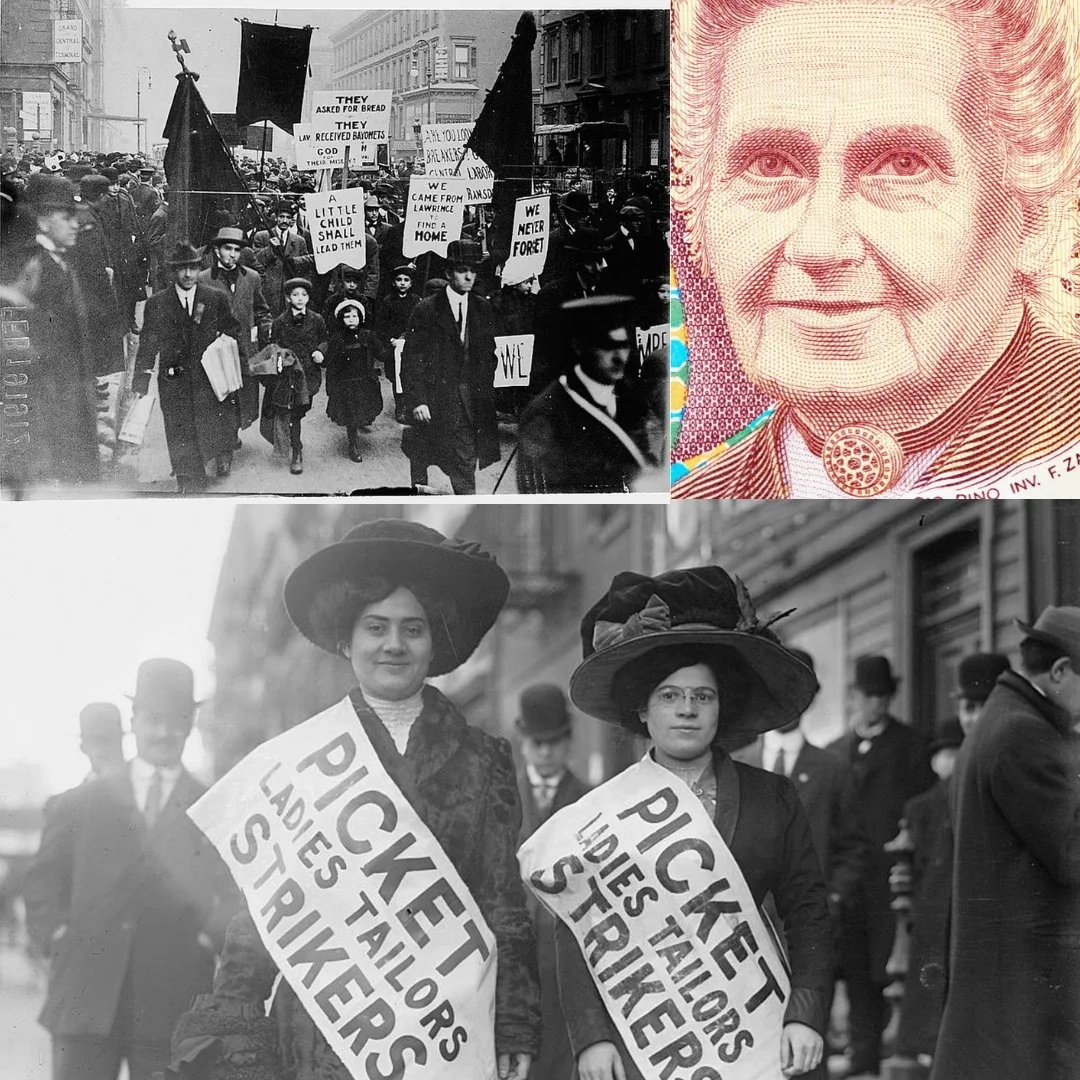
With Dr. Montessori’s birthday this past Monday and Labor Day this long weekend, it got me thinking about Montessori and labor. We know her views on children and their work. We also know that she wrote extensively on adults preparing themselves, but that was meant for teachers. What were her beliefs about the labor workforce during her time? It’s not talked about enough, in a similar way that Helen Keller’s adult life is often not mentioned because of her ties to radical labor movements adjacent to the Communist Party. Keller was even being watched by the FBI! Was Montessori a similar story where that part of her life was purposely suppressed because it was an inconvenient truth?
Upon investigation, it appears that that part of Montessori’s history is not purposefully hidden; it’s just that her pedagogy overshadows other aspects of her philosophy. However, in her early life, by twenty-six she had attended the University of Rome, earned degrees in physics, mathematics, and natural sciences, and then became the first woman in Italy to receive a medical degree on July 10th, 1896! She began working at Rome’s San Giovanni Hospital and entered a network of educated Italian women interested in women’s rights and social reform. Only two months after getting her medical degree, she represented Italy and spoke at the International Congress of Women in Berlin, as somewhat of a celebrity physician and feminist intellectual.
Knowing Dr. Montessori in 1896, you would not think of her as much an educator as a physician and women’s rights advocate. The Stanford Encyclopedia of Philosophy explicitly says that Montessori “was a feminist before becoming a pedagogue.” In Berlin, she spoke about women’s education, working conditions, and equal pay for equal work. Montessori was not only a feminist; she specifically spoke about working-class women and the need to respect their work, dignity, and fair economic compensation. Well before Casa de Bambini, she was showing her strong beliefs in justice, specifically labor justice. Ironically, the conference made her famous, but due to sexist descriptions of her appearance and charm, and not the validity of her ideas, which was infuriating.
In 1912, she released her tour de force landmark work, The Montessori Method, in which she criticized modern education for acting like big labor did before the reforms. The exact quote goes,
“For the age of scientific benches was also the age of the redemption of the working classes from the yoke of unjust labor.”
For context, a “scientific bench referred to school desks, which were touted as preventing spinal deformities. She knew this was bullshit, and she compared it to how bad working conditions physically hurt people. A major goal of the labor movement was to change working conditions. Montessori argued that a school desk does not fix the real problem within the institution of education; it just provides a band-aid to maintain the status quo. She drew a very deliberate parallel between conditions in school and work, but it was still metaphorical.
The nail in the coffin to Montessori’s acknowledgment of her support for the Labor Movement came from,
“The leaders of the people make it their slogan, the labouring masses repeat the cry, scientific and socialistic publications voice the same movement, our journals are full of it.”
This explicitly recognizes the labor movement, socialist publications, and organized workers. She also mentions the underfed worker who needs food, not a medical tonic to keep working. She mentions the miner who doesn’t need a back brace, but an actual break from work, with shorter hours and better working conditions. Ultimately, she argues that we must stop treating the symptoms and fix the actual problems.
Her argument for children's rights is essentially the same as the arguments that we made for adults in the workplace. Why are we subjecting children to garbage working conditions when we are making progress for the adults? She saw the worth and validity of the labor movement and wanted the same protections applied to children, and that had to happen by changing the environment. She saw the school desk as a tool of the child's continued oppression and argued that school needed its own victory for liberty.
We should keep in mind the era she grew up in. When she was born in 1870 in the United States, the Emancipation Proclamation had been signed only seven years earlier, and Juneteenth was five years away. When she speaks of liberty and describes the school desk as “an instrument of slavery,” she is being earnest in this appraisal, for slavery was still very much in recent history. And she argues that civilization is gradually moving towards liberty and away from slavery and oppression (in her case, particularly the oppression of women and children).
“The yoke of the slave yields to that of the servant, and the yoke of the servant to that of the workman.”
This is not just a colorful metaphor, but the underlying belief of her larger theory on human liberation. If we are to recognize the dignity and liberty of the adult worker, we must recognize the dignity and liberty of the child. Montessori believed that work is fundamental to human development. For the child, work is the means of self-construction. For the adult, work is a means of self-expression, independence, contribution, and human dignity. Therefore, neither child nor adult should be liberated from meaningful work; both should be liberated from environments that prevent meaningful work.
Maria Montessori and the Labor Movement
With Dr. Montessori’s birthday happening this past Monday, and Labor Day being celebrated this long weekend, it got me thinking about Montessori and labor. We know her views on children and their work. We also know that she wrote extensively about the work of the adult preparing themselves, although much of that discussion was specifically directed toward teachers. But what were her beliefs about the labor workforce during her time? What did Maria Montessori, the physician and feminist, think about the adults who were working in factories, mines, farms, and workshops?
I initially wondered if Montessori had a similar story to Helen Keller, whose adult political life is often left out of the popular version of her story because of her ties to radical labor movements and socialism. Keller was even monitored by the FBI. Was Montessori a similar case, where her connection to labor and social reform was purposely left out because it was an inconvenient truth?
After looking into it, I don't think so. Montessori's connection to labor isn't really hidden. Her pedagogy has simply become so dominant in the Montessori story that some of her other ideas and political interests have been overshadowed. Looking at her early life, I got a very different picture of Maria Montessori than the one surrounded by children in the Casa de Bambini.
By her mid-twenties, Montessori had studied physics, mathematics, and natural sciences at the University of Rome and was on her way to becoming one of Italy's first women physicians. On July 10, 1896, she became the first woman to graduate in medicine from the University of Rome. She began working at Rome's San Giovanni Hospital and entered a network of educated Italian women interested in women's rights and social reform. Knowing Dr. Montessori in 1896, you would not think of her as much an " educator " as a physician, feminist, and social reformer. The Stanford Encyclopedia of Philosophy explicitly describes Montessori as a feminist before becoming a pedagogue.
Just two months after receiving her medical degree, the 26-year-old Montessori represented Italy at the International Congress of Women in Berlin. She was already well known as a young woman physician and feminist intellectual, so she was given a platform on the international stage. Her subject wasn't just women's education. She spoke about women's working conditions and equal pay for equal work.
Montessori was specifically talking about working-class women and the economic value of their labor. She argued that women doing the same work as men should receive the same pay. This wasn't a passing comment about women's potential. She was talking about women working in factories and on farms and arguing that their work, dignity, and economic independence mattered. Well before the Casa de Bambini, Montessori was publicly talking about justice, and specifically about economic and labor justice.
Unfortunately, the way the press responded to her speaking at the conference could best be described as a comical tragedy. The very conference that helped make Montessori famous was largely shaped by reporting that focused on her youth, beauty, charm, and appearance rather than the substance of what she was actually saying. Instead of simply reporting on the arguments being made by a 26-year-old physician advocating for women's economic equality, some journalists seemed far more interested in reporting on what she looked like. It is difficult to imagine a more perfect example of the problem Montessori was confronting. Her work was judged through the lens of her gender and appearance before anyone considered its substance.
Unfortunately, this isn't a story we look back on and say, " I wonder how they could be so uncivilized. Women today are still routinely judged, sexualized, or evaluated by their appearance in ways that can overshadow their accomplishments, expertise, or message. A woman's appearance has nothing to do with the validity of her argument, the quality of her work, or the value of her contribution. Yet somehow, 130 years later, we still find ourselves having this conversation. The press had an opportunity to tell its readers what Montessori actually said. Instead, some chose to tell them what she looked like. That matters when we are trying to understand the young Maria Montessori.
And this wasn't a one-time appearance. In 1899, Montessori represented Italy again at the International Congress of Women in London, where she spoke about child labor in mines and dangerous trades and the poor working conditions of female elementary schoolteachers. The pattern was becoming pretty clear. Montessori's concern wasn't simply that women deserved access to education or professional opportunities. She was increasingly interested in the conditions under which people worked, and in what those conditions did to human beings.
From Labor to Education
This connection becomes even more interesting in 1912, when Montessori published The Montessori Method. In the book, she criticized modern education by comparing it to the working conditions of her time before labor reforms.
She wrote:
“For the age of scientific benches was also the age of the redemption of the working classes from the yoke of unjust labor.”
The "scientific bench" Montessori was talking about was essentially the school desk. These desks were promoted as a scientific solution to the physical problems caused by children sitting improperly, which led to orthopedic deformities. Montessori herself says that children were working in unhygienic conditions poorly adapted to normal development, "so poorly adapted ... that even the skeleton becomes deformed," so the response was an orthopedic bench. But what is causing the problem? That was Montessori's fundamental critique of these benches. If a child develops physical problems because of the environment we have created, adding a specially designed piece of furniture to that environment doesn't fix the root problem; it only treats a symptom.
Imagine a factory where workers are constantly cutting their hands because sharp pieces of exposed metal are everywhere. The solution isn't to proudly announce that you've ordered more Band-Aids. Or there is poor ventilation, and everyone is getting terrible headaches, but don’t worry, we just purchased enough aspirin for everyone. The solution is to ask why everyone is working around exposed metal in the first place and then remove the hazard.
That was Montessori's point. We created an environment that required children to sit in a particular way for hours, noticed it was causing physical problems, and then tried to engineer a better way for children to stay in the same system. She wasn't interested in making a bad environment slightly less bad. She wanted to question the environment itself. In other words, stop treating the symptoms of poor design and start fixing the design.
The labor movement was arguing that workers shouldn't simply be given medical treatment for the injuries caused by terrible working conditions. The conditions themselves needed to change. Montessori makes exactly this point when discussing the working class. An underfed worker doesn't need some medical tonic to help him continue working while remaining underfed. A miner suffering from the physical consequences of his work doesn't simply need a brace or some other device to compensate for the damage. He needs better working conditions and shorter hours. The solution isn't to make a bad environment slightly more tolerable. Change the environment.
Funny enough, the prepared environment is one of the central ideas of Montessori education. Suddenly, the comparison between the factory and the classroom doesn't look so metaphorical anymore. Montessori borrowed the logic of a broader social reform movement and applied it to education. The worker is being harmed by an environment designed around the needs of production rather than the needs of the human being. The child is being harmed by an environment designed around the needs of the institution rather than the needs of the developing human being. Stop treating the symptoms. Fix the environment.
Montessori and the Labor Movement
Montessori doesn't simply mention workers in passing. She explicitly acknowledges the social and political movement happening around her.
She wrote:
“The leaders of the people make it their slogan, the labouring masses repeat the cry, scientific and socialistic publications voice the same movement, our journals are full of it.”
She is explicitly recognizing the labor movement, organized workers, and socialist publications as part of a larger movement for social change. Montessori wasn't a labor organizer, and I don't think it's accurate to label her simply as a socialist or claim that she adopted the entire political program of the socialist movement. Her relationship with socialism and organized labor was more complicated than that. But she clearly understood the legitimacy of the struggle for better conditions for workers, and she saw something in that struggle that was directly applicable to children. If society was beginning to recognize that adults should not be subjected to unjust working conditions, why were we perfectly comfortable subjecting children to unjust learning conditions?
The Liberation of the Child
This is where Montessori's argument for children's rights becomes much bigger than education. The labor movement was, in part, a struggle over human dignity. A worker was more than a machine for producing something. A worker was a human being whose health, time, body, and economic well-being mattered. Montessori essentially asks us to apply the same logic to children. A child is more than a student who needs to produce correct answers. A child is a human being whose body, time, independence, dignity, and development matter.
This is why Montessori's language about the school desk being an "instrument of slavery" isn't simply colorful rhetoric. She was placing education within a much larger historical movement toward human liberty. Considering the era, the end of slavery in the United States was barely a generation old. While America may not have been at the forefront of her thoughts, at the 1896 women’s conference, part of her message was also a petition against colonial occupation of East Africa. A broader concern with human liberation runs through these different parts of her early political life.
Montessori was born in 1870. The political and social world around her was still wrestling with slavery, colonialism, class hierarchy, women's legal and economic inequality, and the exploitation of workers and children. Across Europe, social reformers were talking about liberation from different forms of domination. Montessori saw history as a gradual movement away from slavery and oppression and toward liberty.
She wrote:
“The yoke of the slave yields to that of the servant, and the yoke of the servant to that of the workman.”
That isn't just a colorful metaphor. It reveals something important about her larger theory of human development. Human beings, she believed, were moving toward greater freedom. However, that freedom wasn't simply freedom from work. It was freedom from the conditions that prevented human beings from doing meaningful work.
Work Is the Connection
This is where I think Montessori's ideas about children's work and the labor movement finally come together. Montessori believed that work is fundamental to human development. For the child, work is the means of self-construction. Through purposeful activity, the child develops concentration, coordination, independence, and ultimately the ability to construct the adult human being they will become. For the adult, work can mean independence, contribution, self-expression, and human dignity.
A worker shouldn't have to choose between dignity and a paycheck. A child shouldn't have to choose between obedience and development. A school shouldn't be considered successful simply because it has found a more efficient way to make children tolerate an environment that was never designed around their development in the first place.
Montessori's educational revolution makes a little more sense when you put it into the context of the social revolutions happening around her. The same century that was beginning to ask, "What does a human being deserve at work?" was also beginning to ask, "What does a human being deserve at school?" Montessori's answer to both questions was surprisingly similar: Respect the human being. Change the environment. Give people the conditions they need to do meaningful work. The liberty we seek is not from work but the freedom to do the work that fulfills our humanity.
If you’ve made it this far, this isn't really an article about whether Montessori "supported the Labor Movement." It’s about how Montessori's philosophy of work didn't begin with children. Before there was a Casa dei Bambini, a young physician was talking about women's economic independence, equal pay, working conditions, child labor, and the dignity of people who work. By 1912, she was taking the logic of those social reforms and applying it directly to education. If the environment is harming the human being, change the environment. If work conditions prevent people from living and developing as human beings, change the conditions of work. She wasn't trying to liberate the child from work. She was trying to liberate the child to work.
So, as we celebrate Montessori's birthday and Labor Day (and my birthday), I wanted to end with a small gift. For Labor Day Weekend, everything in the Montessori Physical Education store is 50% off. I spend a lot of time thinking about the relationship between work, movement, education, and what it means to create environments where people can do meaningful work. This website is one way I get to do that work. So consider this a little Labor Day thank-you for reading all the way to the end. And if you've been thinking about joining Montessori Physical Education, this weekend is probably the best time to do it. The Lifetime Membership is 50% off, so you can access everything currently on the site and everything I'll continue adding in the future.
Thanks for being part of the work that fulfills me as an educator.