
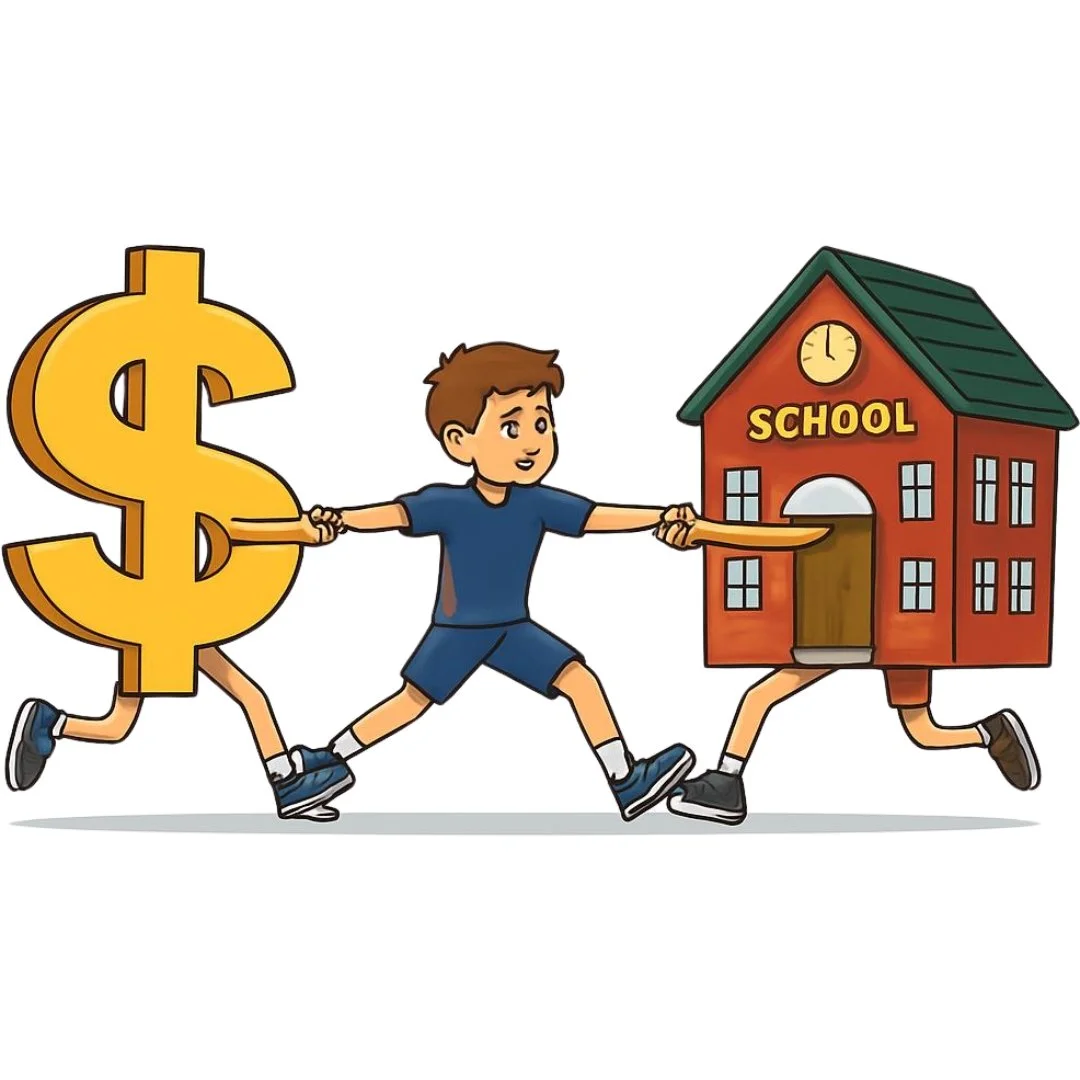
I’ve played sports my whole life. From an early age starting with AYSO soccer leagues where I could barely walk, to a Bulls gymnastics camp at the Broadway Armory (and fencing too), Swim Meets at the Leaning Tower YMCA, Baseball Games at Thillens, tennis camps at McFetridge, Tae Kwon Do, and every single sport offering my grade school offered: basketball, flag football, volleyball, every single year, I played youth sports. The only things I didn’t do were skate or ski. I digress. I know youth sports from having played them my whole childhood. Now, as an adult, I’ve been coaching for seventeen years, and I am finishing my 8th year as the athletic director and PE instructor for my school. Over my forty years of playing and coaching, I’ve noticed a troubling pattern that seems to only be getting worse.
We are currently fighting a losing battle against a corporate machine that has stolen the fun of our children’s sports experience. This is eerily reminiscent of the high school problem that we have here in the heart of Chicago. Chicago has some of the best public magnet high schools in the country. However, this comes at the expense of many of our neighborhood high schools, as money is diverted from them to feed the beast of these elite magnet schools. Obviously, parents want their kids to attend these prestigious (and free) high schools because they want the best for their kids. A completely natural instinct, but the way it manifests in our parent-teacher conferences is parents becoming hyper-anxious about grades, standardized testing scores, and a resume that can push their kid through a flawed selective enrollment point system. Because CPS ranks admissions by neighborhood socio-economic tiers, an average family living in a Tier 4 neighborhood quickly discovers that their child is penalized for their zip code and forced to achieve a near-perfect score to get into the exact same school, while a child from a Tier 1 neighborhood faces a much lower barrier to entry. The system tries to balance equity, but to the average parent caught in the middle, it feels like an unbalanced, high-stakes game with constantly shifting goalposts. It’s harder to get into some of these high schools than it is to get into college, and the parents and kids suffer. So now parents spend thousands for all the tutoring and test prep help they can fit into their kids’ already overbooked lives.
This is exactly how the private, travel-sports industrial complex has taken over our communities. They didn't invent parent anxiety; they just weaponized it. They recognized that the city's educational systems had already conditioned parents to operate from a profound scarcity mindset, which is the deeply ingrained belief that there are only a handful of slots for 'elite' success, and if you aren't actively hoarding opportunities, your child will starve. These predatory corporations took that exact fear of being left behind, that same desperation for an 'edge,' and packaged it into a four-digit annual club fee. They manufactured a sporting arms race out of thin air, convincing you that if you don't buy in right now, your eight-year-old has already lost the game
When I first started the first-ever basketball (and sports) team at our school, it was a parent-driven initiative. Their kids were scattered around the city, playing in whatever league they could find, but all they wanted was to play with their friends and classmates. Maybe because it was new, it was an easy sell, but just being able to play with friends from school was all the enticement they needed. Now, like clockwork, and not just unique to me, as I have this same conversation with my network of athletic directors, familiar faces we expected to see playing are not there. It’s not because they are hurt or had a bad experience with the coach or a teammate; it’s, frankly, disappointing. We too often see a giant gap in our roster because those players got swallowed up by the private, year-round, for-profit league, and it just plain sucks.
Parents in this country have been sold a massive load of shit by a multi-billion-dollar industry about what it takes to get their kids to the pros. And by the way, there is plenty to say about parents who are trying to live out their dreams through their child, but now the typical examples are “normal” parents who are buying into this elite-sports status. The emergence of these year-round travel leagues in all major American sports is a vampire taking blood away from school sports. Plus, it completely rewires family culture because dinner is now either at 4:30 PM or 10:00 PM. Now driving a hundred miles each way is the norm. Now vacations are to the destinations where a tournament is being held. And God forbid if you are a non-sporting kid in one of these families that gets dragged around to it all. Just to feel like they can make the team, kids are forced into a brutal system of hyper-specialization that cripples more than it creates stars. Now we have an epidemic of athletes who play their one main sport at school, and instead of transitioning into the next school sports season with their classmates, they opt out to continue funneling money into an outside private league.
While there is obvious merit to training with a knowledge trainer or coach, the idea that this elite training is the only way to achieve greatness is simply untrue. How many pro baseball players have the same exact story of playing baseball with a broom handle or stick they found and a ball made out of duct tape from sunup to sundown? How did World Cup soccer players play the majority of their childhood soccer barefoot? How many pro NFL linemen’s hardcore training was just working the farm (because those hay bales don’t lift themselves)? Elite athletic development has never required a corporate facility or a high-priced subscription model.
The class warfare that has assaulted our country for decades has found a comfortable home as thousands of dollars a year are sacrificed at the altar of privatized sport. Most people don't realize this is a systemic crisis, but it hasn’t always been this way. I’ve watched our youth sports culture change over the years. The sadder reality is that perhaps the parents know deep down that this isn't the right way, but, like any perceived arms race, you can't be the first to back out. You feel forced to go along and keep up even when you know this isn't optimal. Let’s pull back the curtain on the historical and economic forces that allowed a wealthy, predatory elite to privatize childhood itself.
To understand how we got here directly parallels the differences in economic beliefs between the United States and Europe. How our youth sports developed over time was like a proxy war for the broader cultural war over which system of government and economics is superior: the capitalist United States or Socialist Europe.
The American Scholastic Model: Americanization, Social Control, and the Capitalist Agenda
In the late 1800s, America was facing two massive changes from rapid urbanization and waves of immigration. Young men were moving away from American farm life to the bustling cityscape, working in factories or sometimes going to school. There were many anxieties centered around this change, specifically that young boys were going to become less masculine. Farm life was tough and made bodies stronger; sitting at a desk does not. Boys worked alongside their dads on the farm; now fathers left for work, boys were raised by their mothers and female teachers. There was a new diagnosis called “neurasthenia,” which was supposedly the nervousness induced in a person by overstimulation and the unnaturalness of city living, such as a lack of fresh air and artificial lights.
Another darker reason for this anxiety had roots in xenophobic and racist fear that the newly arriving Catholic, Jewish, and Southern European immigrants were going to usurp the political power and dominance of white Anglo-Saxon culture in the US. The WASPS saw themselves as having direct lineage to the Founding Fathers, so it was only right that they should inherit and control the country. With the influx of so many immigrants, they feared that newly elected Catholics would be subservient to the Pope and move the whole country towards Catholicism, and that wealthy Jewish immigrants would take over banking and financial systems. Working-class Europeans would start workplace revolutions based on socialist principles, as evidenced by a rich history of labor movement organization.
One of the ways to “fix this problem” was to provide indoctrination in the school settings that would “reeducate” these populations to be subservient to the ruling class. If immigrants in big cities were attending public schools, then public schools would be the epicenter of controlling the next generation. They essentially had a captive audience while their parents were working in the factories.
Under the philosophy of “Muscular Christianity,” which was very popular in England during the Victorian era as a rebuke to Puritan ideology, sports and exercise were a superior means of restoring physical and moral health. Its effects would lead to the development of lasting institutions like the YMCA and heavily influence the resurgence of the Olympics. The president Theodore Roosevelt was a believer and promoter of this ideology, captured in this quote: “there is little place in active life for the timid good man.” He saw the utility in the exercise, an aggression outlet, and ultimately, the development of future fighting forces that muscular Christianity would promote.
This history is not a black-and-white issue, but definitely grey. On one hand, institutional forces used sports to strip immigrant children of their cultural identities and force compliance to "American" ideals, molding them into compliant, disciplined cogs for the industrial machine. On the other hand, many immigrant parents were enthusiastic about the idea that sports could "Americanize" their kids. Many of these children had already played traditional European bat-and-ball games similar to American baseball, so their participation in the new "American" sport would, by default, help them blend in and become American. It is very similar to when immigrant parents choose not to teach their children their native tongue so that they learn English more quickly and blend in. You cannot fault families for these survival strategies; it is simply another explanation for why the scholastic system took root so deeply and worked so well.
The European System: The Club Model for Working-Class Democratic Socialism
While America was putting sports into schools to serve the industrial machine and encourage cultural conformity, Europe and socialism made its clear appearance by rejecting aristocratic elitism in favor of sport being for the common person. For a long time, organized sports were only for the elite and wealthy, as seen in British private boarding schools. The ability to play sport was a signifier of your status because the working class did not have time to pursue hobby sports, and when they did play, they were relegated to “amateur” status, which kept athletes unpaid and forced them to work their labor jobs.
There is a saying if you can’t beat them, join them.” I say, if you can’t join them, then beat them at their own game, and that’s what Europe’s massive industrial workforce did. Instead of sport kept to private, elite institutions, it became a democratic sports space through shared clubs and organizations. Because the elite isolated themselves from the plebeians, there was no reason to inject sport into public schools to indoctrinate them, because they were never supposed to be part of them. Many kids of that age were not even going to school but were working from a young age, so the common person found solidarity in the factories they worked in, the churches they attended, the pubs they frequented, and the trade and labor unions they created. These autonomous, community-based clubs started like any other grassroots-level organization, with the participants (the workers) pooling the little extra money they had. An interesting factoid for football (soccer) fans is that many of the famous European soccer clubs today started as factory teams. The Arsenal was a club founded by munitions workers; they were literally making the arsenal!
Following the devastation of World Wars I and II, European governments made it a mission to rebuild society by prioritizing public health. Instead of funding sports in schools, they heavily subsidized the pre-existing community clubs, which were inherently “for the people” because they were made by the common folk. The government collects tax revenue, which is distributed to the sports federations, and the federations’ job is to distribute the money to the municipal-level organizations. This makes for a very well-funded sports enterprise, but private equity did not have a controlling stake. In a democratic socialist worldview, sport is part of the mission of a lifelong public health utility. The United States sees a huge drop-off in sports participation among adults, especially the elderly, but European clubs have masters’ divisions to encourage lifelong participation. It is very hard for elite private sports training to break through in Europe when they can get the same quality of instruction but with a greater sense of community, all for far less than private sports training costs.
The Perversion: The Neo-Elite Travel Circuit in the US
This history matters because the private travel-league industry in America essentially looked at the European club model, hijacked its structure, and ran it through a ruthless, hyper-capitalist filter. The club model has been reintroduced into America, but it has been perverted by capitalism into a new and nefarious form of elitism. Gone is the ethos of community and affordability, non-competitive youth development, and for the good of public health. Instead, they weaponized the American parents' deepest anxieties: the fear of their child falling behind, the obsession with "elite" status, and the multi-million-to-one lottery ticket of a college athletic scholarship.
In 19th-century Europe, you couldn't play sports unless you belonged to the upper aristocratic class. In 21st-century America, you can't play sports “at the highest level” unless your parents can drop thousands of dollars a year on club dues, private trainers, and weekend hotel stays. It is an extractive, predatory industry that takes resources, time, and talent away from local working-class communities and schools and transfers it to the bank accounts of private tournament corporations.
A Nationwide Epidemic: The Geographic Illusion
Many educators and parents assume this is strictly a problem born out of affluent, large metropolitan hubs like Chicago, New York, LA, and Boston. The data shows otherwise. The travel sports industrial complex has successfully privatized youth athletics across the entire country, changing its shape based on geography but inflicting the exact same cultural damage.
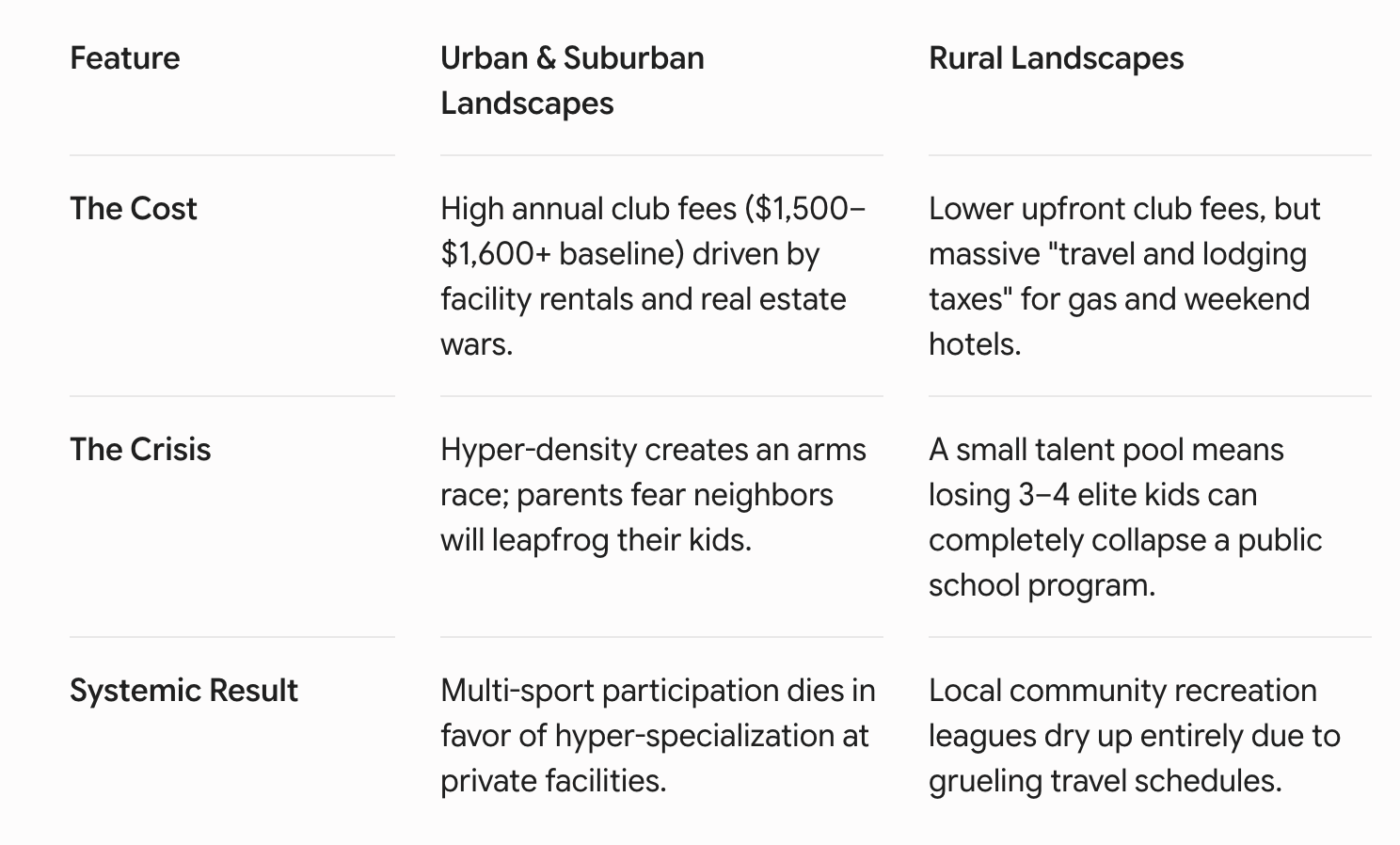
Data from youth sports economic studies reveals that the divide isn't actually geographic, but entirely socioeconomic. Children from high-income households ($100k+) are nearly three times more likely to play on traveling or specialized teams than kids from lower-income families. Whether a parent is paying an LLC for court time in downtown Chicago or spending thousands on highway miles to drive from a rural town to a suburban sports complex, the working-class community is being systematically drained of its talent and its joy.
The Noble Exception
To be entirely fair, not every league operating outside the walls of schools in the US is a corporate predator. There is a notable exception: a parent association that develops organically, does the brunt of the work, and remains strictly volunteer-based. These volunteer-driven leagues are actually the closest thing America has to that European community model. They are democratic, community-focused, and meaningful because the stakeholders are your actual parents and kids, not corporate executives looking for an ROI. They exist to support the kids, whereas corporate travel leagues exist to use the kids to support their bottom line. There is a massive ideological canyon between a $4,000-a-year private travel club owned by wealthy shareholders and a local, volunteer-run town association where moms and dads coach, officiate, and organize all for the love of the game and their children.
How Schools Reclaimed Sports—And How We Are Losing It Again
Despite those not-so-great, capitalistic beginnings born of a desire for social control and to mold disciplined cogs for the industrial machine, the American scholastic model evolved over the 20th century into something truly meaningful and for everyone. Working-class families, local coaches, and neighborhoods hijacked the system back from the elites. Because it adopted a fierce community aspect, youth sports at school became an absolute net positive. It democratized access to sports by being tied directly to public education. For decades, a kid didn't need a wealthy family to play competitive sports; they just needed a pair of sneakers and an annual physical.
It created a deeply rooted, shared local culture. It created the classic "Friday Night Lights" phenomenon: an entire town or neighborhood, regardless of their political or financial differences, sitting in the same bleachers, cheering for the local kids they watched grow up. We see this exact phenomenon right here at our own school when we host a bunch of basketball games and welcome the community to our small, humble school, and the energy in the gymnasium is electric. It became an engine of school pride and lifelong friendships, and a way for our parent body to come together as a community in support of our children.
Before we can convince our athletes to play multiple sports, and before we can examine the physical and medical science showing that specialization is physically destroying their bodies, we have to understand the matrix we are trapped in. I know many of you in the United States who participate in the private, for-profit sports complex wish it weren’t this way, but we must “keep up with the Joneses.” If we could just snap our fingers and change it like Neo taking the red pill, we would. However, to break free from this cycle of year-round singular sport, we must make the decision together as a community that we are not going to participate. It’s going to take the bravery of parents to buck the trend. For example, schools with a no-phone policy and parent buy-in at home dramatically change the culture and experience for the better for their children. One of the strengths and weaknesses of capitalism is that it is money-driven, and every time we spend or refuse to spend our dollars, we are voting. Parents, as individuals, have the choice, but to effect change, we need our parents to come together as communities. Taking a line from Helen Keller, who was a fierce socialist and union supporter, “Alone we can do so little, together we can do so much.”
One final note. Here is a fair critique that sports-literate parents will make. You didn’t leave school sports because of corporate brainwashing. You left because the school lacks resources, has underfunded facilities, or has a well-meaning volunteer coach who doesn’t know the game or how to manage the kids. You were forced to outsource your child’s development to private clubs to ensure quality instruction. The thing is,1 you are not entirely wrong. But this is where our collective panic has paralyzed us. By taking your knowledge, your child’s talent, and your financial resources out of the school ecosystem to feed a private club, you are ensuring that school sports stay underfunded and under-resourced. If you are a parent who truly knows the game, don't run away to a private LLC. Bring your expertise back to the school or parent-driven community league and invest your time into those programs. A huge amount of credit for the success of our sports programs at my school goes to the parent volunteer coaches who give their time and expertise not only to their children but also to their children's friends and teammates. They make themselves an anchor of the school community, and an invested parent body is the best type of parent body.
Be on the lookout for part two, which will look at the benefits of being a multi-sport athlete and the negative health consequences of playing one sport year-round.
Bibliographies
· Cavallo, D. (1981). Muscular Christianity: Emigrant Children and the Development of Organized Play inside American Cities, 1879–1920. University of Pennsylvania Press.
· Coakley, J. (2006). The Privatization of Youth Sports: What Happens When Commodified Play Replaces Community Recreation? Research Digest, 7(3), 1-8.
· Eisenberg, C. (2011). The Rise of International Football: A Study in Cultural Diffusion. International Journal of the History of Sport, 28(14), 1912-1926.
· Guttmann, A. (2004). From Ritual to Record: The Nature of Modern Sports. Columbia University Press.
· Holt, R. (1990). Sport and the British: A Social History. Oxford University Press.
· Macleod, D. I. (1983). Building Character in the American Boy: The Boy Scouts, YMCA, and Their Forerunners, 1870-1920. University of Wisconsin Press.
· Riordan, J., & Krüger, A. (Eds.). (2003). European Cultures in Sport: Examining the Nations and Regions. Intellect Books.
· The Aspen Institute Project Play. (Annual Reports). State of Play: Youth Sports in America. The Aspen Institute.