
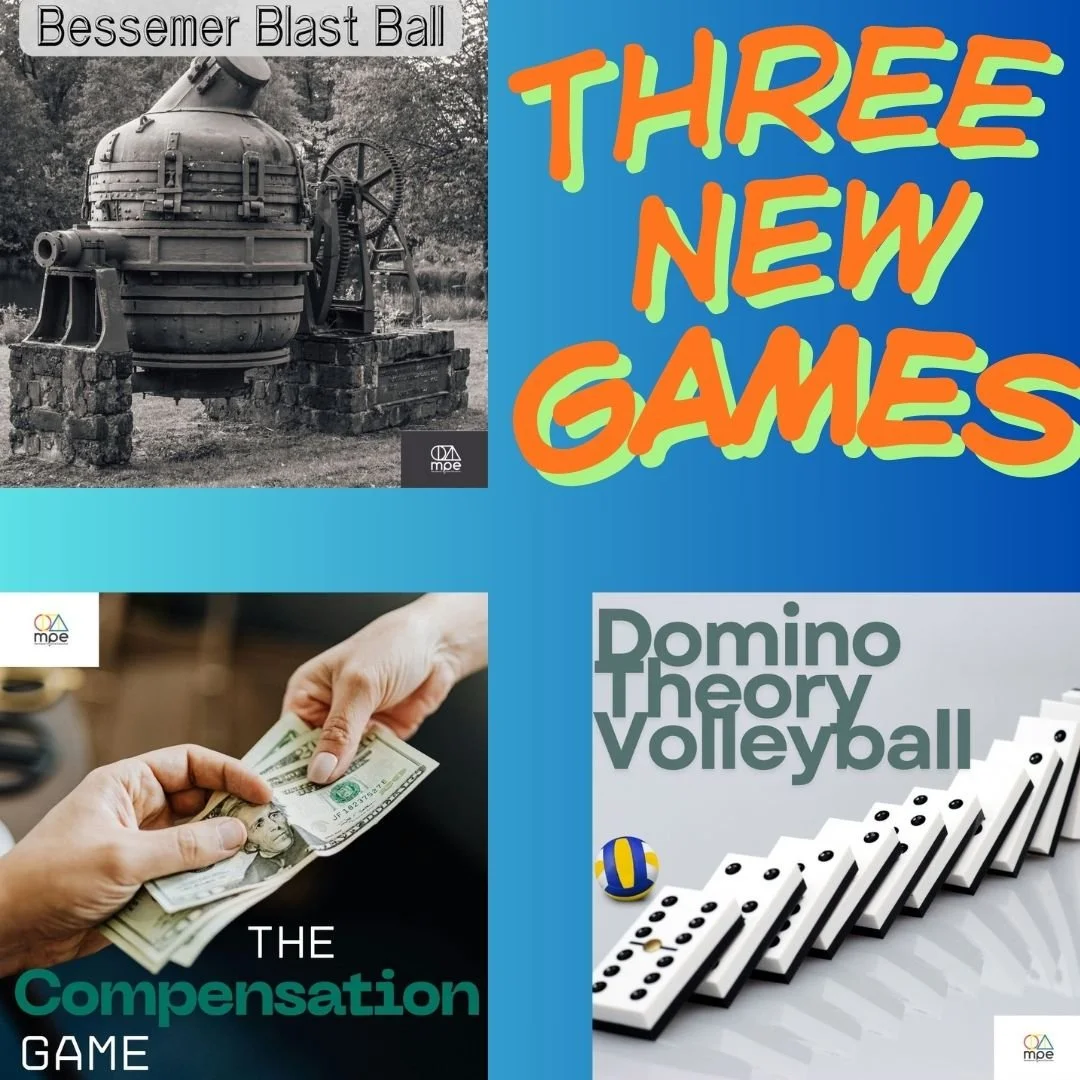
This past week, I’ve added three new lessons to our Montessori Physical Education curriculum, primarily designed for upper elementary and middle school students. These games don’t just get bodies moving; they help students experience important themes from American History in a way that feels dynamic, relevant, and connected to their academic work.
One of the goals in Montessori Physical Education is to give students a meaningful context for their movement. When games mirror real historical systems or ideas, students begin to understand those concepts more deeply. Play is one of the best ways to learn, and these lessons capture the essence of learning through movement.
Why This Matters Specifically for Montessori Adolescents
As students move into adolescence, their academic work becomes far more abstract. They’re expected to wrestle with complex systems, conflicting perspectives, and ideas that don’t always have a single correct answer. While this shift is developmentally appropriate, the more esoteric the concept being learned, the less connection the student may feel to it.
That’s why offering adolescents concrete, embodied ways to explore abstract concepts is so powerful. In Montessori, we use materials to bridge that gap, but movement-based games can serve a similar purpose. When historical ideas are “gamified,” students suddenly gain context, clarity, and personal investment in concepts that might otherwise get glossed over in a traditional history lesson.
Depending on the textbook or teacher, history can easily be presented through a particular lens, which can unintentionally sound preachy. But when students play a concept, the consequences of their decisions unfold naturally within the game. They make meaning for themselves.
A great example is Domino Theory Volleyball. Adults still disagree about whether American intervention during the Cold War was necessary to halt the spread of communism, or whether the loss of life and enormous financial cost outweighed the intended goal. Instead of telling students what to think, the game allows them to feel what can happen when one “falling domino” impacts the entire system. They experience the tension, the uncertainty, and the responsibility that help them form their own conclusions and understand the choices made in the past.
Something similar, but different, happened during a lesson of Bessemer Blast Ball. After learning that oxygen blasts away impurities such as carbon, sulfur, and silica, a student asked a thoughtful question:
“But I’ve heard of carbon in steel—so why are we blasting it out?”
I didn’t know the answer offhand, so we explored it together later. It turns out that steelmakers found it more efficient to burn out all the carbon, then reintroduce the exact amount needed. Once you hear it, it sounds obvious. However, the question itself showed exactly what we hope for: a student applying prior knowledge to a new concept, thinking critically, and deepening the learning for both of us.
This is the heart of Montessori PE at the adolescent level. Below is a closer look at each new lesson and how it can support your classroom’s exploration of American History. If any of them spark your interest, simply click the lesson’s title image to explore the full write-up.
1. Bessemer Blast Ball
Historical Connection: Industrial Revolution, Technological Innovation, Labor & Production
“Bessemer Blast Ball” helps students feel the urgency and innovation of the Bessemer steel process, a key turning point in the Industrial Revolution. As students rebuild, recharge, and protect their “furnaces,” they begin to understand how a leap in efficiency reshaped American cities, transportation, and industry.
It pairs beautifully with lessons on urban growth, new technologies, and the rapid changes that defined the late 19th century.

Click the image to learn more!
2. Domino Theory Volleyball
Historical Connection: Cold War Foreign Policy, Containment, U.S. Intervention
This lesson brings Cold War tension to life. Students experiment with the principles behind the Domino Theory, the logic that shaped decades of U.S. foreign policy. The chain-reaction scoring mirrors the delicate balance leaders feared could collapse with one misstep.
It’s a natural fit alongside studies of the Vietnam War, containment, and shifting political ideology during the Cold War.

Click the image to learn more!
3. The Compensation game
Historical Connection: Labor Systems, Wealth Gaps, Power Dynamics
These scoring-based games introduce students to the mechanics of economic inequality through movement and strategy. The “first scorer becomes CEO” structure highlights how early advantages compound and shape future outcomes—mirroring the realities of wealth distribution across U.S. history.
Because the scoring model works across several sports, it fits easily into a variety of PE rotations.

Click the image to learn more!
A Final Note
My goal with these lessons isn’t to persuade students of a particular viewpoint—it’s to give them opportunities to move, question, discover, and connect ideas across disciplines. If you’re exploring these topics in your American History curriculum, these games can help bring those conversations to life in a way that feels genuinely Montessori because they are hands-on, inquiry-driven, and grounded in real experience.
All of these newly updated lessons are available individually in the Lesson Library and have already been uploaded to the Members’ Area. If you’re a member—especially a lifetime member—it’s worth checking back every month or so. You automatically receive every new or updated lesson the moment it’s published, so you always have access to the latest version of every game I create.
These three new lessons are part of an ongoing commitment to giving you fresh, integrated resources that bring movement and deep learning to your students.
If you'd like to dive deeper into any of the lessons, just click the title image above each description to learn more.